
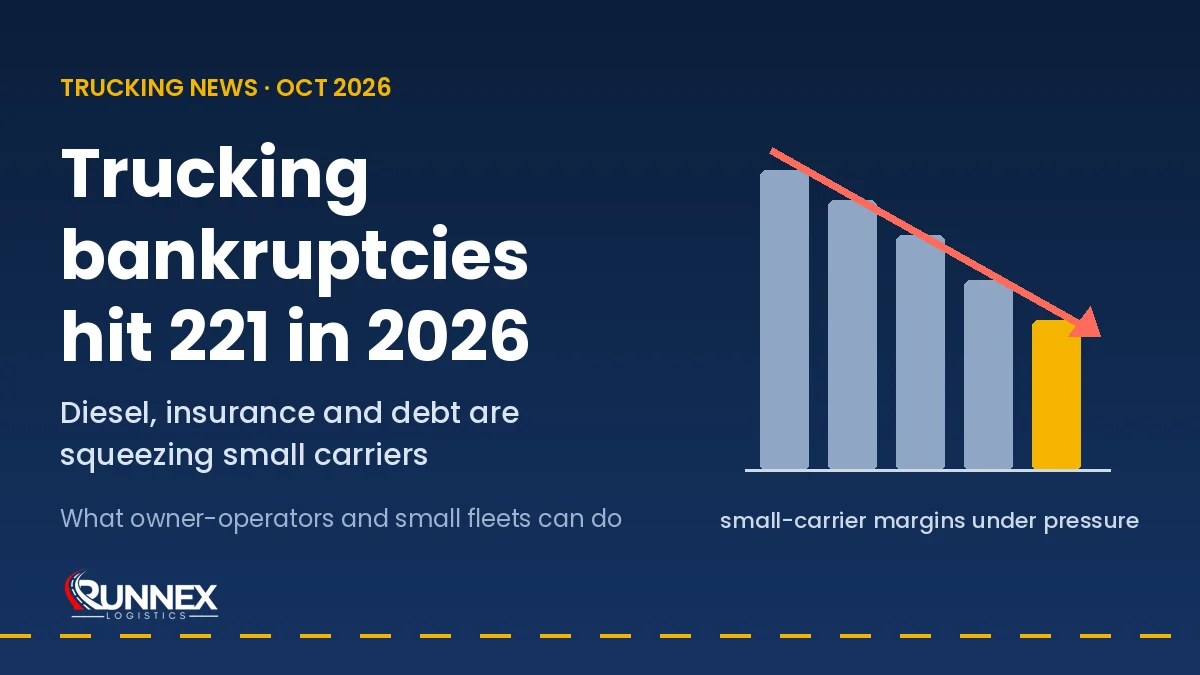
Trucking bankruptcies have reached 221 so far in 2026, and small carriers are taking the hardest hit. A Bloomberg report published October 28 says diesel, insurance and debt costs are squeezing owner-operators and small fleets. Here is what happened, what it means for you, and six steps to protect your cash flow.
Key takeaways
- Bloomberg counts 221 trucking company bankruptcy filings so far this year.
- About two-thirds of small carriers in a Truckstop and Bloomberg Intelligence survey said revenue is flat or down.
- Almost 40% expect to be out of trucking in six months, or are not sure.
What happened
On October 28, 2026, Bloomberg News published a report on small carriers under financial stress. Transport Topics and Insurance Journal also ran the story. According to data compiled by Bloomberg, 221 trucking companies have filed for bankruptcy so far this year. Bloomberg says that extends a three-year spike at levels not seen in decades.
The report also cites a survey of hundreds of small carriers. Truckstop and Bloomberg Intelligence ran it over the past two months. Small carriers here means fleets with 20 or fewer tractors, and often just one truck. About two-thirds said revenue is flat or down. In addition, almost 40% said they may be out of trucking within six months, or are unsure.
Bankruptcy lawyers quoted in the story describe a “triple whammy”: higher fuel prices, rising interest rates and costly credit. Many small operators finance trucks with variable-rate loans. Some also lean on short-term loans and merchant cash advances, which add heavy costs later.
Insurance is another pressure point. For example, one Michigan fleet owner was quoted $155,000 to insure two trucks and three trailers. That quote came after one of his drivers had an accident. He is now shutting his business down.
Fuel may not get cheaper soon, either. Fuel and truck stop executives spoke at the WEX OTR Summit on October 27. They warned that diesel could stay high until at least spring 2027, FreightWaves reported. They pointed to limited refining and pipeline capacity.
What it means for owner-operators and small fleets
Large carriers can spread fuel and insurance costs across thousands of trucks. A one-truck operation cannot. That is why the rise in trucking bankruptcies is mostly a small-carrier story. As a result, every empty mile, cheap load and late payment hurts more right now.
The report also notes a split in the market. Carriers with no equipment debt and solid safety records are doing well. On the other hand, carriers with heavy debt and thin cash reserves are struggling. So the goal is simple: protect your margin per mile and keep cash coming in on time.
Fraud adds more risk. The report says identity thieves target carriers with long, clean records. That is why our guide on freight fraud and double brokering is worth a read.
How to avoid trucking bankruptcies: 6 steps for small carriers
- Know your real cost per mile. Add up fuel, insurance, truck payments, maintenance and your own pay. Then divide by total miles, including empty miles. Do not book loads below that number.
- Cut fuel waste first. Plan fuel stops, limit idling and watch your speed. Our post on how owner-operators can protect margins from diesel prices has more ideas.
- Reduce deadhead miles. Plan your next load before you deliver. Even a short backhaul is often better than a long empty run.
- Read your loan and advance terms. Before you sign a merchant cash advance or short-term loan, check the true total cost. If a deal looks confusing, ask an accountant or lawyer first.
- Protect your safety record. Insurance costs can rise after one accident or even a speeding ticket. Clean inspections and safe driving keep premiums lower over time.
- Get paid faster. Send clean invoices with signed BOLs the same day you deliver. Then follow up on every unpaid load. Good invoice management and dispatch support helps you keep cash flowing.
How Runnex helps
Runnex Logistics has supported owner-operators and small fleets since 2014. Our truck dispatch services include dispatching, freight coordination, invoice management, paperwork and compliance support, and 24/7 driver support. In other words, we look for loads that fit your lanes and your cost per mile. Meanwhile, we keep your paperwork moving so you get paid. We dispatch Dry Van, Reefer, Flatbed, Step Deck, HotShot and Power Only.
Frequently asked questions
How many trucking companies went bankrupt in 2026?
According to data compiled by Bloomberg, 221 trucking companies filed for bankruptcy as of late October 2026.
Why are small trucking companies struggling?
The main reasons are high diesel prices, rising insurance costs and expensive debt. In addition, about two-thirds of surveyed small carriers say revenue is flat or down from last year.
Will diesel prices drop soon?
Some fuel and truck stop executives expect diesel to stay high until at least spring 2027. So it makes sense to plan your rates around current fuel costs.
Can a dispatcher help a small carrier stay profitable?
Yes. A good dispatcher helps you avoid cheap loads, cut empty miles and keep invoices on track. That way, more of each load stays in your pocket.
Want a second set of eyes on your lanes and rates? Contact Runnex Logistics or call (574) 240 6239 for a free dispatch consultation.
Protect your margins with Runnex
Runnex Logistics finds loads, handles broker paperwork and keeps your invoices moving, so your truck earns more per mile. Explore our dispatch services for owner-operators or get a free quote.
Sources
- Transport Topics / Bloomberg News (Oct 28, 2026): Small trucking companies file 221 bankruptcies in 2026
- Insurance Journal / Bloomberg (Oct 28, 2026): Trucking companies confront mounting diesel, insurance, debt costs
- FreightWaves (Oct 28, 2026): Diesel prices may stay elevated into spring 2027, fuel executives warn
One Response